Punctuation..? by User Design

User Design has very kindly sent me a free copy of Punctuation..? to review. (I haven’t had any previous involvement with User Design and I am not receiving any kind of payment for this review.)

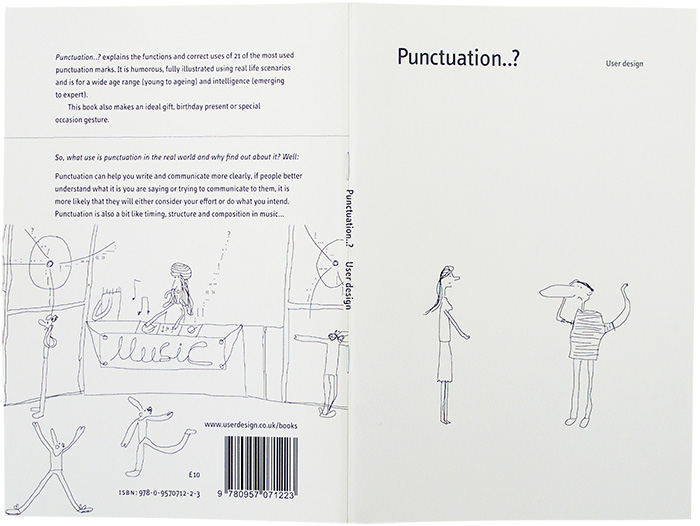
Punctuation..? aims to explain the functions and uses of 21 punctuation marks. The intended audience seems to be broad, but the content is focused on the British English use of punctuation.

It is a slim book at 36 pages. It is staple bound (or saddle stitched) with the title of the book on the spine.
Used with permission from User Design.

Image used with permission from User Design.

Printed on good quality paper, it feels nice in the hand. However, I don’t think this can help to justify the £10 price tag.

The illustrations are idiosyncratic but charming. They are the main selling point of this publication. Readers who are easily bored should find the often amusing drawings enough reason to keep reading.

I was very pleased to see en dashes and em dashes touched on as well as hyphens. I was also interested to see guillemets, interpuncts and pilcrows included.

Unfortunately, the book is let down by errors, clunky prose and a lack of clarity. I find some of the explanations to be unhelpful or slightly misleading. This is a shame because Punctuation..? could be an excellent introductory guide after a little polishing.
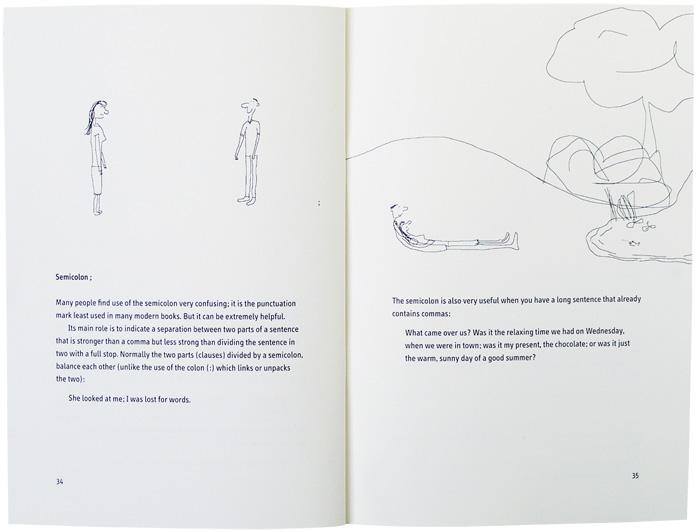
Image used with permission from User Design.

Image used with permission from User Design.

The book is ideal if you want to spark someone’s interest in punctuation. It would also be ideal for a child who finds the topic of punctuation difficult or intimidating.

For adults, you might enjoy it as a quirky primer. But if you want to know how to use punctuation correctly, I can’t recommend anything more than Trask’s Guide to Punctuation.

‘Flaw’ and ‘floor’

Flaw:

  • an imperfection, mark or blemish
  • a mistake or shortcoming in something that makes it invalid, causes it to fail, or reduces its effectiveness
  • a fault or weakness in a person’s character.

Floor:

  • the lower surface of a roomhttps://pixabay.com/en/stuttgart-library-white-books-980526/
  • a storey of a building (rooms or areas on the same level)
  • a flat bottom surface
  • a minimum limit or level
  • the part of a legislative hall in which members sit and debate is conducted
  • the large central hall where trading takes place in a Stock Exchange
  • to provide a room/area with a floor (or as an adjective e.g. ‘a marble-floored room’)
  • to have the right to speak in a debate or discussion – ‘have the floor’
  • to disconcert, baffle or defeat; to knock someone to the ground.

Split infinitives

An infinitive is the form of a verb made by adding to to its stem (e.g. to go or to do).

It is often argued that there should never be anything between the to and the stem. In Latin, the infinitive is a single word.  This has led to the belief that the infinitive in English should be treated as a single unified concept, and that it is bad grammar to separate the two parts.

It is not bad grammar to split an infinitive; there is no grammatical reason not to. It is sometimes impossible to convey your meaning without splitting the infinitive. Sentences quite often read better when the infinitive has been split.

The most famous example of a split infinitive is probably to boldly go (from Star Trek). Would to go boldly or boldly to go have the same emphasis? No. Are they more natural? No.

As with ending a sentence with a preposition, there are circumstances where it would be more appropriate to avoid splitting the infinitive. It might be, for instance, jarring to split it.

You may also find that some publications would rather that you didn’t split infinitives lest you upset people by doing so. For that reason, The Economist’s Style Guide sadly declares that the ban on split infinitives is ‘pointless’ but that you should observe it anyway.

I’m not sure how healthy it is to obey a ‘rule’ that isn’t a rule just to keep your readers from confronting that it isn’t a rule.

If you want to read people agree with me, here are some books you should take a look at:

  • For Who the Bell Tolls: One Man’s Quest for Grammatical Perfection, David Marsh.
  • Fowler’s Dictionary of Modern English Usage, Jeremy Butterfield (editor).*
  • Oxford A–Z of Grammar and Punctuation (Second Edition), John Seely.
  • Oxford Guide to Plain English (Fourth Edition), Martin Cutts.
  • The Chicago Manual of Style (Sixteenth Edition).
  • The Penguin Writer’s Manual, Martin Manser and Stephen Curtis.

* Fowler’s suggests that you should avoid splitting infinitives but also states that it is acceptable and often necessary.

(To make things even more complicated, I recommend Trask’s The Penguin Dictionary of English Grammar for an explanation of why you aren’t actually splitting an infinitive at all.)

Thank you to Lucy aka Blondeusk for suggesting this post.

‘Whine’ and ‘wine’

I bring you more homophones.

Whine:

  • a long, high-pitched plaintive cry; a long, high-pitched unpleasant sound
  • to issue a long, high-pitched cry or sound
  • a petulant complaint
  • to whinge or complain.

Wine:

  • https://pixabay.com/en/wine-rose-glass-glasses-pink-791133/an alcoholic drink produced by the fermenting of grapes (usually with sugar and water)
  • an alcoholic drink produced by the fermenting of other fruits and flowers (usually with sugar and water)
  • a dark purplish-red colour.

You can wine and dine someone by offering them (usually lavish) drinks and a meal, or you can wine and dine as you enjoy yourself by eating and drinking.

Thank you to Jeff Curry for suggesting this post.

Pooh-bah

A pooh-bah is a person who has a lot of power and/or influence. They may hold (but not necessarily fulfill) many offices at the same time, and they are often seen as pompous or self-important.

The word originates from a character in W. S. Gilbert’s The Mikado (1885). In the opera, Pooh-Bah bears the title ‘Lord High Everything Else’; his behaviour matches the definition above.

‘Its’ and ‘it’s’

When I am proofreading, I often find that it’s is used when its would be correct. I https://pixabay.com/en/notepad-pen-paper-writing-business-926046/think that this occurs because the writer is thinking about apostrophes as a way to show possession. However, its is a possessive pronoun. It doesn’t need an apostrophe because it is already the possessive form of it.

Its means ‘belonging to it’.

It’s means ‘it is’ or ‘it has’.

The following are also possessives and don’t require an apostrophe: hers, his, mine, yours, theirs and ours.

‘Tire’ and ‘tyre’

In British English, these are the spellings for two words with different meanings.

Tire:

  • to reduce the energy of (usually by exertion); to feel or cause to feel in need of sleep/rest
  • to become bored with or lose interest in something; to exhaust the patience of.

Tyre:https://pixabay.com/en/tires-waste-disposal-recycling-904945/

  • a ring of rubber fitted round the rim of a wheel of a road vehicle to form a soft contact with the road
  • a band of metal fitted round the rim of a wheel (typically of a railway vehicle).

In American English, tire is the standard spelling for both meanings. Tyre is actually thought to be a variant of the old form tire (a shortening of attire because the tyre was seen as the ‘clothing’ of the wheel).

Thank you to Aeryn Rudel for suggesting this post.

Are you on tenderhooks?

No, but you might be on tenterhooks.

If you are on tenterhooks, you are in a state of suspense or agitation because of uncertainty about an event in the future.

Tenterhooks were hooks that held cloth firmly in place on tenters. Tenters were wooden frames used to stretch cloth after it had been milled. They were used so that cloth dried evenly and didn’t shrink.

The first usage of tenterhooks in the sense of suspense can be found in Tobias Smollett’s novel The Adventures of Roderick Random, published in 1748: “I made no reply, but left him upon the tenter-hooks of impatient uncertainty.”

Alley-oop

This term will probably be familiar to basketball fans.

The word alley-oop was first used in the early 20th century, and it is suggested that it originates from the French allez! (meaning ‘go on’ said in an encouraging way) and an alteration of up.

https://pixabay.com/en/basket-hoop-basketball-game-net-821529/An alley-oop or alley-oop pass is a high pass caught above the basket by a leaping player who tries to dunk the ball before landing.

Alley-oop can also be used as an exclamation. It encourages or draws attention to the performance of a physical feat (often acrobatic).

There is a song by the Hollywood Argyles titled Alley Oop; it was inspired by a comic strip of the same name. I prefer the version that the Beach Boys released. Here it is:

You’re welcome.