Proofreading guide for students

Late last year I wrote and published a series of posts on proofreading advice. This is the first of those posts: Proofreading advice: take a break.
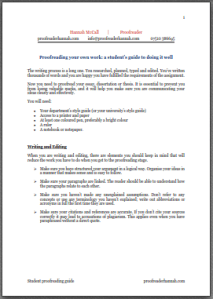
GuideI have put a lot of that advice into a PDF guide that is now available on my Resources and Information for Students pages. You can also download it by clicking on the image opposite.

My 4-page guide has been written primarily for students. I enjoy working on dissertations and theses, but not all students can use the services of a proofreader. If you aren’t allowed to use professional help, or if money is tight, I hope this guide will be of some assistance.

It contains four steps to help you prepare for proofreading your own work, as well as a list of common errors to look out for. The common errors include mixed -ize/-ise endings, incorrect use of apostrophes, and references that aren’t according to style.

Authors may not find all of the advice relevant to them, but they will probably find some of the information of use.

‘Foul’ and ‘fowl’

Here’s a faintly seasonal mix-up with an accompanying adorable picture.

Foul

  • offensive, obscene or vulgar; unpleasant
  • foul smelling or dirty; full of dirt or offensive matter
  • evil, wicked or immoral
  • bad tempered, cross or irritable
  • unfair or dishonorable; against the rules of a sport
  • to make dirty or polluted; to spoil or damage
  • to come into conflict with (‘fall foul of’)

FowlDucklings

  • a domesticated bird such as a chicken
  • a bird raised or kept for food, or hunted as game
  • the meat of fowl
  • a bird; a collective term for birds

Ducklings are fowl and not foul. (Although, like all baby things, they are full of offensive matter that will go everywhere. And it stains. So I think that illustrates foul/fowl is a matter of perspective.)

Horripilation

ColdHorripilation is the erection of hairs on the skin caused by cold, fear, excitement or other emotion.

The OED provides one early definition from 1656:

Horripilation, the standing up of the hair for fear..a sudden quaking, shuddering or shivering.” Glossographia, Thomas Blount.

The word originates from the Latin horrere meaning (of hair) ‘to stand on end’ and pilus meaning ‘hair’. Horrere also means ‘to tremble’ or ‘dread’.

Something that causes this reaction is described as horripilant. Horripilate is the form meaning ‘to undergo or to cause horripilation’.

‘Practice’ or ‘practise’?

Confusion over the use of practice and practise is common. For most varieties of English, practice is the spelling for the noun and practise is the spelling for the verb.

DeskVerb:

I practise every day.

Noun:

It is my practice to write every day.

If it is a thing, use practice. If it is an action, use practise. I find it helpful to link them to advice and advise. Most English speakers instantly know the difference:

Verb:

I advice advise you to stop.

Noun:

I gave you some advise advice.

The word with the -ice ending is a noun. The word ending with -ise is a verb. And you can apply that to practice and practise.

In American English, practice is the dominant spelling for the noun and the verb. However, the distinction is sometimes observed.

‘Pair’, ‘pare’ and ‘pear’

Pair, pare and pear are homophones. I sometimes see pair used when pare or pear would be appropriate. It depends on the context, but it can be very confusing when these words are used incorrectly.

Pair

  • a set of two
  • a thing with two joined parts (e.g. a pair of shorts)
  • to put together to form a pair

PearsPare

  • to trim by cutting away the outer edge or layer
  • to reduce something

Pear

  • the edible fruit and its tree


Lallygag

DanceLallygag (or lollygag) is an American slang word. It means ‘to spend time aimlessly’, ‘to be idle’ or ‘to fool around’. It can also mean ‘dawdle’ or ‘dally’.

The origin appears to be unknown. The word forms include lallygagged and lallygagging.

The OED gives examples of early usage, and this one caught my eye:

“The lascivious lolly-gagging lumps of licentiousness who disgrace the common decencies of life by their love-sick fawnings at our public dances.” Northern Vindicator (Estherville, Iowa), 1868.

That’s impressive alliteration and I only wish I could view the rest of the newspaper article (or letter – I bet it’s from a letter).

The Penguin Writer’s Manual, Martin Manser & Stephen Curtis

The Penguin Writer’s Manual features on my list of recommended books and my own bookshelf. The blurb describes it as follows:

The Penguin Writer’s Manual is the essential companion for anyone who wants to master the art of writing good English. Whether you’re composing an essay, sending a business letter or an email to a colleague, or firing off an angry letter to a newspaper, this guide will help you to brush up you communication skills and write correct and confident English.

via The Penguin Writer’s Manual.

BookshelfThe book isn’t as belligerent as that passage makes it sound. The value of this book is probably not in the depth of its explanations. If you need a quick refresher on what an adverbial phrase or a preposition is, this will help. The sections on word usage and vocabulary are also useful.

I think the value of this book is in its advice. The Penguin Writer’s Manual was published in 2002, but its content is still surprisingly relevant. (I am still coming to terms with 2002 being a long time ago.)

If you need to write a business letter but you aren’t sure what to include, the guidelines are well explained with examples of good practice. Other types of communication you may not do on a daily basis are also addressed, such as letters of sympathy or job references.

The authors also give more general advice, including discussions on style and effective communication. Much of the advice is easy to understand and apply, and yet in some ways profound:

One of the wisest uses of time is to think about precisely what it is you wish or need to say.

The book has 352 pages and would be easy to tuck into your bag if you wanted to work outside. You can find the book and more reviews on Amazon, but you can probably pick up a second-hand copy for a very reasonable amount.

‘Ingenious’ and ‘ingenuous’

These two words are easily confused, and often wrongly selected by autocorrect when you aren’t paying attention to the keys you are hitting.

LightbulbIngenious

  • clever, inventive and/or original
  • displaying cleverness or originality; well suited for its intended purpose

Ingenuous

  • innocent, trusting or unsuspecting; unsophisticated
  • honest and straightforward

You can work out which word you need by remembering that a genius is often ingenious.

Pie-biter

It’s British Pie Week. It is therefore only fitting that this week’s interesting word should be related to pie.

PieA pie-biter is a person who eats or really likes pies. It can also be a greedy person or animal, or a person who accepts political favours (pie is a slang word for political favour or patronage).

Although rare, pie-biter is a colloquial term typically used in the United States or as derogatory slang in Australia (where the meaning is often ‘a fat person’).

The origin of the word is straightforward: pie meaning ‘a baked dish with a pastry top and/or base’ and biter meaning ‘someone who or something that bites’.

The earliest documented usage in the OED is from 1863.

Blog anniversary

Today marks the first anniversary of the creation of proofreaderhannah.com. I almost can’t believe it has been one year already.Office

I don’t think I would have managed to produce 113 posts in that time if it wasn’t for the support of those who read this blog. Thank you. I really appreciate your contributions.

I published a list of 2015’s most popular posts, but for this milestone I would like to highlight some of my favourite posts:

  1. Irregular verbs. Lots of people struggle with verb forms and I put together a 6-page PDF to help. It includes notes on usage differences around the world.
  2. Taradiddle. The interesting word with an origin story that illustrates its meaning. Managing to incorporate Harry Potter into the post was a bonus.
  3. Sample style sheet. A style sheet for an imaginary novel. Style sheets are an excellent tool and this is an example for any authors who want to know where to start.
  4. ‘Affect’ and effect’. I like this mostly because the comments took me from Pirates of the Caribbean to Pokémon.
  5. Punctuation..? by User Design. I was thrilled that an author asked me to review their work, but I had to be honest with my readers.
  6. Split infinitives. I really stuck it to the man with my support of split infinitives (and ending a sentence with a preposition).
  7. The Penguin Guide to Punctuation, R. L. Trask. Because no one should be afraid of punctuation. I think people actually bought this book after I recommended it. If that was you, I hope you are still finding it useful.
  8. ‘I.e’ and ‘e.g.’ are not interchangeable. A short, simple and effective post.
  9. Noel. I enjoyed writing Christmas-related posts, and I am already thinking of words to discuss this year!
  10. Proofreading advice: take a break. I wrote a series of posts on proofreading advice and I think this is the best one. It isn’t often that doing nothing is the best thing to do.

And now I’m going to have a cup of tea and some chocolate biscuits to celebrate properly.