Rub-a-dub

https://pixabay.com/en/drummers-drums-soldiers-historic-642540/You might be familiar with a nursery rhyme about three men in a tub. Or the BBC’s version about socks (if my socks had that many holes, I would just get rid of them).

Rub-a-dub was originally a word for the sound made by beating a drum or for a drumming sound.

It is often used to describe a rhythmic sound or motion, such as rubbing or scrubbing to make something clean.

Rub-a-dub is also rhyming slang for pub.

Proofreading advice: take a break

I’m tinkering with a guide to help students who wish to proofread their own work, and I thought I would share some of the advice on my blog.

You’ve finished writing. You’ve made your edits. The next step is to proofread.

Don’t.

https://pixabay.com/en/snow-winter-cold-white-landscape-616319/

     If it looks like this outside, you know where you should be.

Save your work. Put down your pen. Switch off the computer. Take a break.

The best thing to do, I think, is to go outside. Take a walk and get some fresh air. If you can’t go out, do something else to take your mind off the work. Bake a cake, knit a small hat, clean the bathroom. Do whatever you like doing to relax.

If you have enough time, leave your work for a day or more.

This should create distance, and distance should help you spot errors. When your words are not fresh in your mind, you can look at your writing from a different perspective.

That’s when it’s time to start proofreading.

Articles in this series:

‘Palate’, ‘palette’ and ‘pallet’

I must admit I have to think very carefully about these three.

Palate:

  • the roof of the mouth
  • the sense of taste or ability to distinguish between and appreciate flavours
  • the flavour of wine and beer

Palette:

  • a flat, thin board used by artists to mix paints
  • the range of colours characteristic of a particular artist or school of painting, also the range of colours used in a particular painting
  • the range of colours, patterns or shapes that can be displayed on the visual display unit of a computer
  • the range of tonal colour in a piece of music

Pallet:

  • https://pixabay.com/en/pallets-wood-pile-wooden-745422/a straw-filled mattress or bed; a crude, temporary or makeshift bed
  • a tool (often wooden) with a flat blade used for shaping clay or plaster
  • a portable platform for stacking, storing and moving goods
  • a projection on a machine part that changes the motion of a wheel

Pallet also has specialist uses in relation to timepieces and heraldry.

Catty-cornered

https://pixabay.com/en/cat-kitten-rozko%C5%A1n%C3%A9-little-wood-914110/

Sorry Britishers, it has nothing to do with cats. Here’s a picture of one anyway.

This week’s interesting word is (I believe) common in American English but almost unknown in British English.

It is a variation of cater-cornered. There are other variations including catacornered, caddy-cornered and kitty-cornered.

Cater-cornered means ‘diagonal’ or ‘diagonally’. It is used to describe something as situated diagonally opposite from something else.

Cater-corned is mid 19th century in origin. It is usually considered to have developed from a dialect use of cater meaning ‘diagonally’. This stemmed from cater meaning the four-spot on dice, which comes from the French quatre meaning ‘four’. Quatre is from the Latin quattuor, meaning ‘four’.

‘Fewer’ or ‘less’?

It is common for less to be used when fewer would be appropriate.* The correct usage basically boils down to whether you’re referring to something that can or cannot be counted.

Use fewer with countables and less with uncountables.

If you mean smaller in number, use fewer. This applies when you are referring to people or things in the plural. You can count them, e.g. books, students.

If you mean smaller in quantity, use less. This applies when you are referring to something that doesn’t (normally) have a plural. You cannot count it, e.g. music, mud.

You should also use less when referring to a number on its own and expressions of measurement and time. Less is also correct when referring to age and sums of money. This is because you are referring to the total amount rather than individual units. (This is usually expressed as less than. For example, less than sixty miles, less than £80, less than four years.)


* The use of less in front of nouns that can be counted (count nouns) is not a new phenomenon. King Alfred the Great did it in c.888. The rule against using less in front of plural count nouns is usually traced back to one grammarian writing in 1770 (and it was not intended to be as strict as it has become in modern usage). It will be interesting to see if using less with count nouns becomes acceptable once more.

‘Defuse’ and ‘diffuse’

Defuse

  • to remove the fuse from (an explosive device)
  • to reduce the tension or danger in (a difficult situation).

Diffuse:

  • https://pixabay.com/en/glass-water-lemonade-diffusion-red-1017451/to spread over a wide area (or between a large number of people)
  • to mix (a gas or liquid) through or into a surrounding substance
  • to cause light to spread evenly
  • spread out over a wide area; not concentrated or localised
  • lacking conciseness or clarity.

‘Disinterested’ and ‘uninterested’

Some people get very upset when disinterested is used to mean the same thing as uninterested.

  • Disinterested: unbiased or objective
  • Uninterested: having or showing no interest in someone or something

Disinterested was used to mean uninterested in the 17th century, and modern usage suggests that disinterested is often considered a synonym of uninterested.

However, I would recommend maintaining the distinction in formal writing. This helps to avoid any confusion over your meaning.

I wouldn’t worry too much about the usage in informal writing or in everyday conversation.

‘Tact’, ‘tack’ and ‘task’

In my experience, it is common for people to get confused when using ‘tact’ and ‘tack’.

Tact:

  • a sense of (and an ability or will to use) the best and most considerate way to deal with people (so as not to upset them)
  • skill in handling difficult situations or issues

Tack:

  • a course of action or policy, or a way of dealing with a problem or situation
  • a small, short sharp-pointed nail with a large flat head; to fasten something or fix in place with a tack or tacks
  • to add something to an already existing whole – ‘to tack something on’
  • a drawing pin (in North American English)
  • a long loose temporary stitch used to fasten fabrics together; to sew something with long loose temporary stitcheshttps://pixabay.com/en/horse-spring-brown-blue-sky-muzzle-742424/
  • the riding harness for horses, including saddles and bridles
  • the act of changing course by turning a boat’s head into and through the wind (creating a zigzag course to make progress against the wind); the boat’s course relative to the wind’s direction; the distance sailed between tacks
  • a rope for securing a certain type of sail; the corner a rope is fastened to
  • being sticky (as a quality or property)

Task:

  • a specific piece of work to be done or undertaken
  • an unpleasant or difficult job or duty
  • to assign or give a job or piece of work to
  • to make demands on someone’s resources or abilities
  • to criticize or rebuke – ‘take to task’

Thank you to Johanna Levene aka Afthead for suggesting this post.

Damp squid

I really like this eggcorn. It makes sense: squid live in water and I imagine living in water makes you damp. I’m not sure why damp squid are seen as failures or as disappointing; that seems rather unfair on them.

The phrase is actually damp squib. It is usually considered British English.https://pixabay.com/en/fireworks-red-night-sky-rays-1002817/

A damp squib is a situation or event which is less impressive, exciting or popular than expected.

A squib is a type of firework or firecracker. Small explosives used in the military and in industry are also called squibs. If a squib gets damp, it won’t go off.

To British readers – I hope your Bonfire Night wasn’t a damp squib. If you are going to see fireworks this weekend, I hope you have a wonderful time! (Fireworks are one of my favourite things.)

Widows and orphans

If you are self-publishing your work, it is worth knowing about widows and orphans. They can be ugly, and removing them will help your finished publication look even more professional.

Widows

The first type of widow is a short last line of a paragraph at the top of the page. The definition of ‘short’ will vary. Generally, you can pick your preference out of the following:

  • less than a third of the line width
  • less than half of the line width
  • less than the full line width

I prefer to regard ‘short’ as less than the full line width. Whichever definition you wish to adopt, make sure that you are consistent throughout.

As the author, you are well placed to decide how to deal with any widows that occur: add or remove some text on the previous page so that the line can move up or another line can move down (or just make the line longer if that’s what you want).

Make sure you check any for any knock-on effects. Sometimes even small changes have repercussions for the surrounding pages.

Here is an example of a widow.

Here is an example of a widow.

The second type of widow is a very short last line of a paragraph. This is usually fewer than five characters (including punctuation). You should be able to deal with these by adding or removing a word or two earlier in the paragraph.

Paragraphs that are only one line do not count as widows.

Orphans

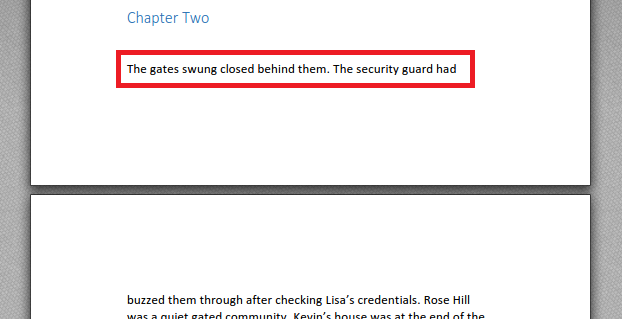
Orphans are a single line of text under a new heading at the bottom of the page. If the first line of a paragraph falls at the bottom of the page, it is sometimes also regarded as an orphan.

Here is an example of an orphan.

Here is an example of an orphan.

As suggested above, you can add or remove words to fill or create space. It will depend on the capabilities of the formatting software you are using, but you might be able to amend the space above and below headings and illustrations.

If you can think of a sensible way to save or add space, it is probably worth doing when you are faced with a widow or orphan.


My definition of widows and orphans is based on that stated in Basic Proofreading by Distance Learning (Fourth Revision) by Gillian Clarke and Margaret Aherne.