Capitalisation: family relationships

Writers are frequently confused about when to capitalise words such as mum and dad. It isn’t as complicated as it may seem. The general principles are as follows:

FamilyIf you are using the word in place of their name, you should capitalise:

I'm cooking dinner for Mom
She asked Dad to mow the lawn
"Oh no," said Grandma

This applies if you are using the word as a title as part of their name:

We went to visit Uncle Gareth
"I've got things to do," said Grandpa Joe

If you are using the word as a label – a description of relationship or kinship – you should not capitalise:

I'm cooking dinner for my mom
Jenny's grandmother plays tennis
He looks just like his brother

You can usually tell if you need a capital letter by substituting a proper name and deciding if it sounds strange:

I told Mother the cat ran away 
I told Helen the cat ran away
I told my Mother the cat ran away
I told my Helen the cat ran away
I told my mother the cat ran away

This isn’t foolproof because people do say ‘my Helen’ or ‘our Helen’ to distinguish between multiple Helens or to imply relation. However, the use of a possessive pronoun (my, your, his, her, our or their) is often a good indicator that you should not capitalise.

This is my second post on capitalisation (the first one was on capitalising months and seasons), and it is an expanded answer to Erik Porter’s question about whether to capitalise mom in the phrase my mom. I hope it helps!
‘Accept’ and ‘except’

Accept and except sound very similar, and the similarity causes confusion for some writers. If you are one of them, don’t feel bad about it. Accept and except have been muddled up for centuries; Fowler’s states that Queen Elizabeth I made the error in one of her letters.

Accept:Yes

  • to take or receive something offered
  • to agree to

Except:

  • not including; apart from
  • to leave out or exclude

My tip to help you use the correct word is to try to remember that accept means agree and both words begin with a.

Tellurian

EarthThis week’s interesting word is likely to be well known to lovers of science fiction.

Tellurian can be used as an adjective to mean ‘of, inhabiting or relating to the earth’. Readers, writers and watchers of science fiction will probably be familiar with the noun meaning ‘an inhabitant of the planet earth’.

Tellus (or tellur) is the Latin word for earth or ground. Tellus is also the name of the goddess of the earth in Roman mythology or a personified version of the earth (usually female).

Tellurian was used to refer to the earth in the late 18th century, as shown here:

"It will show the heliocentric position of the telurian orb." A Short Account of the Solar System, Bartholomew Burges. 1789.

Its use to mean ‘a person from the planet earth’ was established and flourishing in fiction by the mid 19th century. The text the following example is taken from is available to read on Google Books:

[Spoken by the Man in the Moon] "What monster have we here?—Away, Tellurian!" Blackwood's Magazine, May p555. 1828.

Source: The Oxford English Dictionary (online)

Capitalisation: months and seasons

I know some writers find it hard to use capital letters correctly; New Hart’s Rules has an introduction to capitalisation you might find reassuring:

Capital letters in English are used to punctuate sentences, to distinguish proper nouns from other words, for emphasis, and in headings and work titles. It is impossible to lay down absolute rules for all aspects of capitalisation … the capitalisation of a particular word will depend on its role in the sentence, and also to some extent on a writer’s personal taste or on the house style being followed.

The most important thing, I think, is to consider why you have used a capital letter – nouns don’t automatically need one.

There are some general principles you can use to guide you. The convention for months and seasons is fairly simple. I have included days and festivals below because they are often queried at the same time.

Days

The names of days are capitalised:

She was born on a Wednesday
Can I visit next Saturday?

Months

The names of months are capitalised:

The referendum will be held on 23 June 2016
I'm going on holiday in April

Seasons

The names of seasonSprings are not capitalised:

I like to visit the beach in summer
There was a distinct lack of snow this winter

However, you should use a capital letter if you have personified the season:

And Winter shook his frosty mane
The warm sun ended Spring's slumber

Festivals and holidays:

The names of festivals, holy days and holidays are capitalised:

We are preparing for Ramadan
I don't like Halloween
What are you doing on May Day?

If you would like more information on using capitals, I recommend starting with Trask’s Guide to Punctuation. If you would like additional guidance, New Hart’s Rules is a useful style guide for UK publishing and is fairly thorough on the topic on capitalisation.


References:

New Hart’s rules: the handbook of style for writers and editors (2014) 2nd edn. Oxford: Oxford University Press.

Trask, R. L. (1997) The Penguin guide to punctuation. London: Penguin Books.

‘Climactic’ and ‘climatic’

The similar spelling here makes it so easy to use the wrong word, accidentally type the wrong word, or miss the incorrect usage when you are reading over your own work.

Climactic means ‘forming a climax’:

  • The viewers gasped during the climactic final fight scene
  • Mounting tension gave way to a climactic resolution

ClimateClimatic means ‘relating to climate or weather’:

  • My hair doesn’t react well to these climatic conditions
  • The researchers are worried about climatic change

My advice is to try to remember there is no extra c in climatic because climate does not have an extra c. Or there’s a more complicated association with climactic and cinema (because that’s where you often watch films with big climactic scenes).

Proofreading guide for students

Late last year I wrote and published a series of posts on proofreading advice. This is the first of those posts: Proofreading advice: take a break.

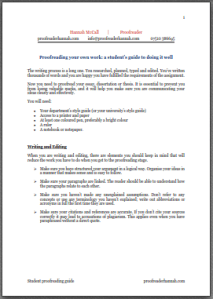
GuideI have put a lot of that advice into a PDF guide that is now available on my Resources and Information for Students pages. You can also download it by clicking on the image opposite.

My 4-page guide has been written primarily for students. I enjoy working on dissertations and theses, but not all students can use the services of a proofreader. If you aren’t allowed to use professional help, or if money is tight, I hope this guide will be of some assistance.

It contains four steps to help you prepare for proofreading your own work, as well as a list of common errors to look out for. The common errors include mixed -ize/-ise endings, incorrect use of apostrophes, and references that aren’t according to style.

Authors may not find all of the advice relevant to them, but they will probably find some of the information of use.

Damp Squid: the English language laid bare, Jeremy Butterfield

I was given a copy of Damp Squid: the English language laid bare for Christmas. I’d like to say one of my best friends knows me so well that this was a gift he picked himself, but I asked for the book and he called me a nerd when he gave it to me.

This is the publisher’s description:

How many words are there in the English language and where were they born? Why does spelling ‘wobble’ and why do meanings change? How do words behave towards each other – and how do we behave towards words? And what does this all mean for dictionary-making in the 21st century? This entertaining book has the up-to-date and authoritative answers to all the key questions about our language.

Source: Damp Squid

Jeremy Butterfield edited the recent edition of Fowler’s Dictionary of Modern English Usage and I have shared some of his articles on Twitter. I admire his work; I think he is an eminently sensible man.

Damp Squid is aimed at a British audience but I am sure an American reader would understand most of the references (or at least understand them enough in context).

I think it is fair to describe the book as a love letter to the Oxford Corpus. The corpus is made up of global English texts, of all types, that can be read electronically. From this, researchers can draw conclusions about how the English language is being used.

BookshelfButterfield uses the corpus to explore the evolution and usage of English. He focuses on how the language is used rather than on prescribed ideas of how it should be used. If you have read some of my previous posts, you are probably aware that I usually write about standard usage rather than ‘correct’ usage. The book gives a good overview of how standard is determined and the problems that arise from trying to present one ‘correct’ version of English.

You might think that a book taking a close look at spelling and grammar would be dry and a bit dull. On the whole, Damp Squid is entertaining and interesting. Butterfield is mostly successful in balancing depth of information with amusing examples (“spam rage – the incandescent anger caused by dozens of emails offering to enhance parts of your anatomy you were perfectly happy with”). The discussion is accompanied by explanatory tables of usage statistics and illuminating quotes from such figures as Samuel Johnson.

All the chapters are clearly written and accessible. You don’t have to be a language expert to enjoy the book but an interest in the English language is probably required.

Two of my favourite chapters are those on where words come from and words that often group together. You might recognise the eggcorn in the title: damp squid. It appears in the chapter discussing idiomatic phrases, and the chapter is fascinating (especially the section comparing idioms from different languages).

I read Damp Squid in a few enjoyable hours (it is 165 pages excluding notes and index). You can find more reviews on Amazon, and you can probably acquire a second-hand copy for a reasonable amount if you fancy adding it to your bookshelf. Or you could start your Christmas list early.

‘Foul’ and ‘fowl’

Here’s a faintly seasonal mix-up with an accompanying adorable picture.

Foul

  • offensive, obscene or vulgar; unpleasant
  • foul smelling or dirty; full of dirt or offensive matter
  • evil, wicked or immoral
  • bad tempered, cross or irritable
  • unfair or dishonorable; against the rules of a sport
  • to make dirty or polluted; to spoil or damage
  • to come into conflict with (‘fall foul of’)

FowlDucklings

  • a domesticated bird such as a chicken
  • a bird raised or kept for food, or hunted as game
  • the meat of fowl
  • a bird; a collective term for birds

Ducklings are fowl and not foul. (Although, like all baby things, they are full of offensive matter that will go everywhere. And it stains. So I think that illustrates foul/fowl is a matter of perspective.)

Horripilation

ColdHorripilation is the erection of hairs on the skin caused by cold, fear, excitement or other emotion.

The OED provides one early definition from 1656:

Horripilation, the standing up of the hair for fear..a sudden quaking, shuddering or shivering.” Glossographia, Thomas Blount.

The word originates from the Latin horrere meaning (of hair) ‘to stand on end’ and pilus meaning ‘hair’. Horrere also means ‘to tremble’ or ‘dread’.

Something that causes this reaction is described as horripilant. Horripilate is the form meaning ‘to undergo or to cause horripilation’.

‘Practice’ or ‘practise’?

Confusion over the use of practice and practise is common. For most varieties of English, practice is the spelling for the noun and practise is the spelling for the verb.

DeskVerb:

I practise every day.

Noun:

It is my practice to write every day.

If it is a thing, use practice. If it is an action, use practise. I find it helpful to link them to advice and advise. Most English speakers instantly know the difference:

Verb:

I advice advise you to stop.

Noun:

I gave you some advise advice.

The word with the -ice ending is a noun. The word ending with -ise is a verb. And you can apply that to practice and practise.

In American English, practice is the dominant spelling for the noun and the verb. However, the distinction is sometimes observed.